

Java for-each Loop: Syntax and Usage Explained
☰Fullscreen
Table of Content:
For-each loop
- The for-each loop introduced in Java5.
- It is mainly used to traverse array or collection elements.
- The advantage of for-each loop is that it eliminates the possibility of bugs and makes the code more readable.
- It works on elements basis not index.
- It returns element one by one in the defined variable.
- It is easier to use than simple for loop because we don't need to increment value and use subscript notation.
Syntax
for(Type var:array){
    //code to be executed
}
or
for(data_type variable : array | collection){
    //code to be executed
}
Java For-Each Loop Flowchart
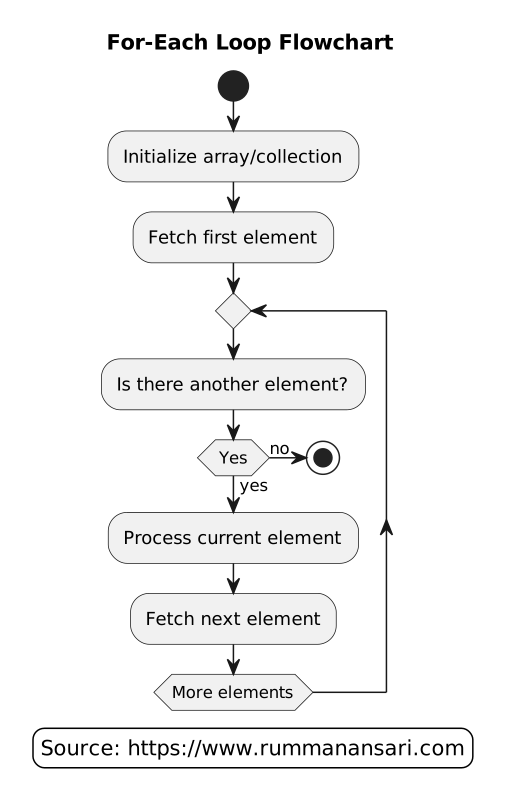
Example of for each Loop
/*
Demonstrate the for each loop.
save file "ForEachExample.java".
*/

public class ForEachExample {
public static void main(String[] args) {
    int array[]={10,11,12,13,14};
    for(int i:array){
        System.out.println(i);
    }
  }
}
Output:
10
11
12
13
14
Press any key to continue . . .
Example of for each Loop
/*
Demonstrate the for each loop.
save file "ForEachExample.java".
*/

import java.util.*;
class ForEachExample{
  public static void main(String args[]){
   ArrayList list=new ArrayList();
   list.add("Rumman");
   list.add("Jaman");
   list.add("Student");

   for(String s:list){
     System.out.println(s);
   }

 }
}
Output:
Rumman
Jaman
Student
Press any key to continue . . .
- Assignment 1: for each loop in java
- Assignment 2: Break statement in for each loop in java
- Assignment 3: Continue statement in for each loop in java
- Assignment 4: Printing the Fibonacci Series using Iteration different approach
- Assignment 5: Simple Triangle Pattern in Java.
- Assignment 6: Square Pattern in Java