The correct Java statement is:
class Child implements Father, Mother
{
}
Understanding the Diagram:
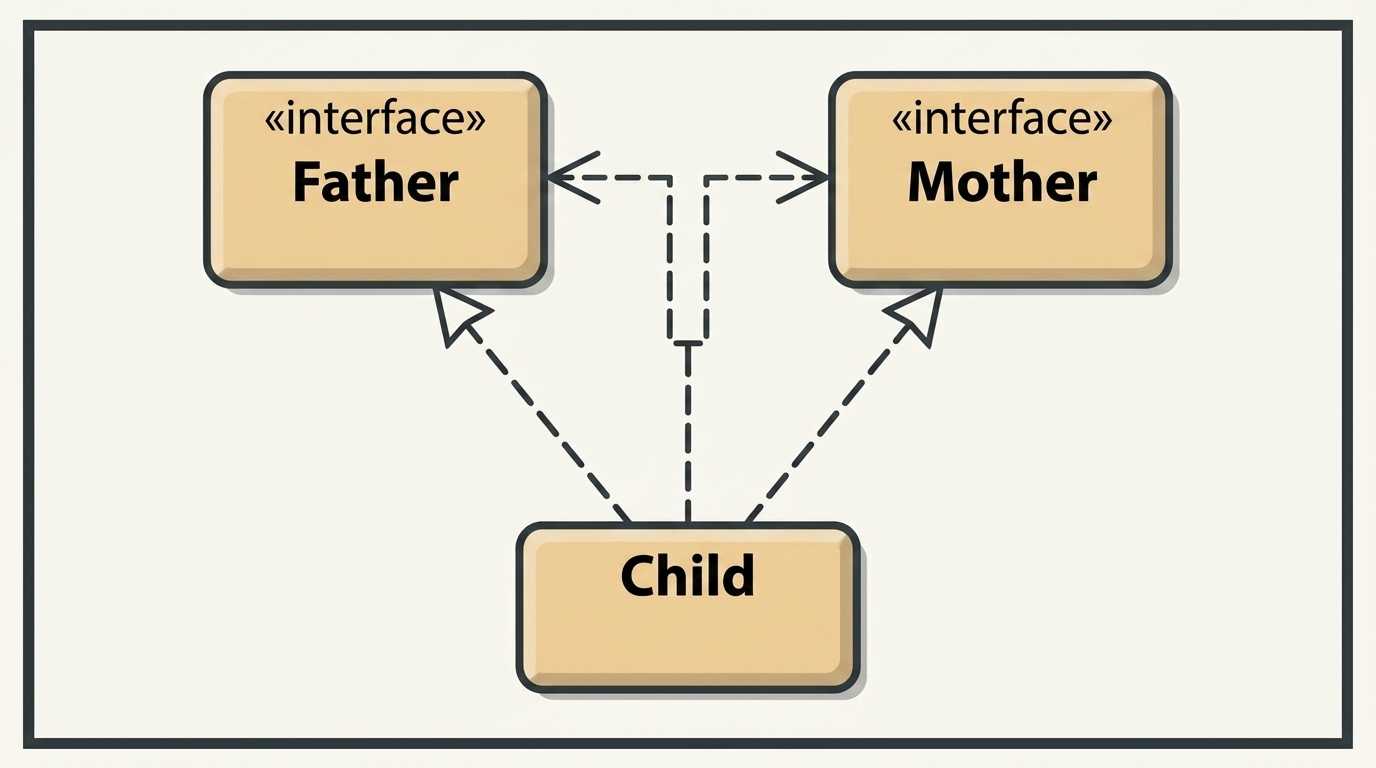
The image shows:
-
Two interfaces:
Father and Mother
-
One class:
Child
-
The class Child is connected to both interfaces
This represents:
Multiple Inheritance using Interfaces
Important Concept:
In Java:
-
A class cannot extend multiple classes
-
But a class CAN implement multiple interfaces
Syntax for Implementing Multiple Interfaces:
class ClassName implements Interface1, Interface2
{
}
Applying to the Given Diagram:
| Component |
Type |
| Father |
Interface |
| Mother |
Interface |
| Child |
Class |
Therefore, the class declaration becomes:
class Child implements Father, Mother
{
}
Why implements is Used?
The keyword:
implements
is used when a class inherits behavior from interfaces.
Why extends is Not Used?
extends is used for:
- Class-to-class inheritance
- Interface-to-interface inheritance
But here:
- Child is a class
- Father and Mother are interfaces
So Java requires:
implements
Example with Method Implementation:
interface Father
{
void showFather();
}
interface Mother
{
void showMother();
}
class Child implements Father, Mother
{
public void showFather()
{
System.out.println("Father Method");
}
public void showMother()
{
System.out.println("Mother Method");
}
}
Final Conclusion:
-
The diagram represents multiple inheritance using interfaces.
-
A class implements interfaces using the keyword
implements.
-
Therefore, the correct statement is:
class Child implements Father, Mother
{
}