✏️ Explanatory Question
Answer with Explanation
A data entity is an abstraction from the physical implementation of database tables. For example, in normalized tables, a lot of the data for each customer might be stored in a customer table, and then the rest might be spread across a small set of related tables. In this case, the data entity for the customer concept appears as one de-normalized view, in which each row contains all the data from the customer table and its related tables.
A data entity encapsulates a business concept into a format that makes development and integration easier. The abstracted nature of a data entity can simplify application development and customization. Later, the abstraction also insulates application code from the inevitable churn of the physical tables between versions. To summarize: Data entity provides conceptual abstraction and encapsulation (de-normalized view) of underlying table schemas to represent key data concepts and functionalities.
A data entity in Dynamics 365 Finance and Operations (D365 F&O) is a logical representation of a table or view in the database. Data entities are used to expose data to external systems and to provide a consistent way to interact with data within D365 F&O.
A D365 data entity is a concept in Microsoft Dynamics 365 Finance and Operations that represents a specific set of data that can be imported or exported to or from the application. Data entities provide an abstraction layer between the application and external systems, enabling easy integration with other applications and data sources.
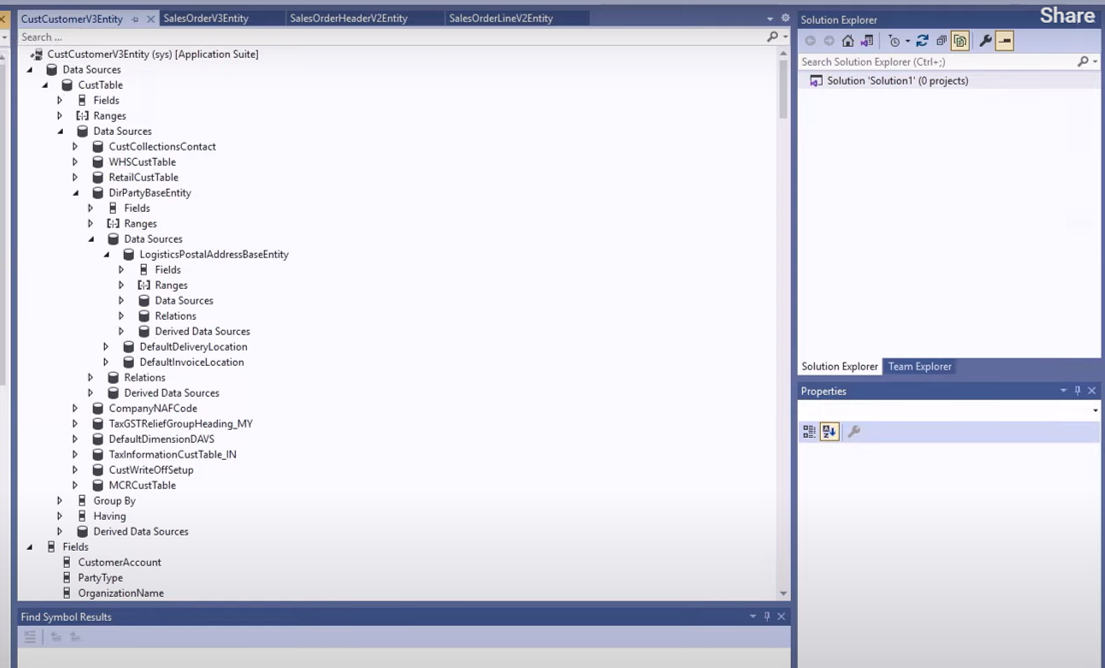
Data entities in D365 are defined by metadata, which describes the structure of the data and its relationships to other entities. This metadata is used by the application to generate code and provide a user interface for working with the entity.
Each data entity in D365 is based on a specific table or set of tables in the application's database. The data entity includes all of the fields in the underlying tables, as well as any related data that is required to provide a complete view of the data.
Data entities in D365 can be used for a variety of purposes, including data migration, data integration, and reporting. They can be customized to meet specific business requirements, and new entities can be created as needed to support new data sources or integrations.
In summary, a D365 data entity is a standardized, abstract representation of a set of data in the application that enables easy integration with external systems and provides a flexible, extensible way to work with data.
Data entities can be used to:
- Import and export data
- Integrate with external systems
- Develop custom applications
Data entities are created using the Data Entity Designer. The Data Entity Designer provides a graphical interface for creating and configuring data entities.
When creating a data entity, you must specify the following:
- The name of the data entity
- The table or view that the data entity represents
- The columns that should be included in the data entity
- The permissions that should be granted to the data entity
Once you have created a data entity, you can use it to import and export data, integrate with external systems, or develop custom applications.
Here are some of the benefits of using data entities in D365 F&O:
- Consistency: Data entities provide a consistent way to interact with data within D365 F&O. This can help to improve the reliability and performance of applications that access data.
- Flexibility: Data entities can be used to import and export data, integrate with external systems, and develop custom applications. This gives you a lot of flexibility in how you use data in D365 F&O.
- Security: Data entities can be used to control who has access to data and what they can do with it. This can help to protect your data from unauthorized access.
If you are looking for a way to improve the consistency, flexibility, and security of data access in D365 F&O, then data entities are a great option.
Here are some examples of how data entities can be used in D365 F&O:
- Importing and exporting data: Data entities can be used to import and export data from a variety of sources, including spreadsheets, flat files, and other databases. This can be useful for loading data into D365 F&O or for exporting data for analysis or reporting.
- Integrating with external systems: Data entities can be used to integrate D365 F&O with external systems, such as ERP systems, CRM systems, and accounting systems. This can help to improve the flow of data between D365 F&O and other systems.
- Developing custom applications: Data entities can be used to develop custom applications that access data in D365 F&O. This can be useful for automating tasks, creating reports, or building custom business intelligence solutions.