✏️ Explanatory Question
Answer with Explanation
 #include <stdio.h>

int main()
{
    int a[10][10], i, j, sum = 0, m, n;

    printf("Enter the row and column of matrix: ");
    scanf("%d %d", &m, &n);

    // Check for square matrix
    if (m != n) {
        printf("Diagonal elements exist only for square matrix.\n");
        return 0;
    }

    printf("Enter the elements of matrix:\n");
    for (i = 0; i < m; i++) {
        for (j = 0; j < n; j++) {
            scanf("%d", &a[i][j]);
        }
    }

    printf("\nThe matrix is:\n");
    for (i = 0; i < m; i++) {
        for (j = 0; j < n; j++) {
            printf("%d\t", a[i][j]);
        }
        printf("\n");
    }

    // Sum of diagonal elements
    for (i = 0; i < m; i++) {
        sum = sum + a[i][i];
    }

    printf("\nSum of the diagonal elements of the matrix is: %d", sum);

    return 0;
}
Output
Enter the row and column of matrix: 3 3
Enter the elements of matrix: 2
3
5
6
7
9
2
6
7
The matrix is
2 3 5
6 7 9
2 6 7
Sum of the diagonal elements of a matrix is: 16
Explanation:
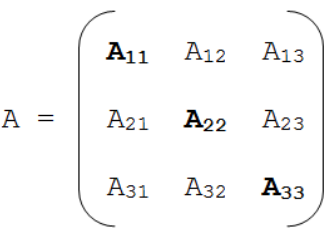
Diagonal elements have been shown in the bold letter. We can observer the properties any element A ij will diagonal element if and only if i = j