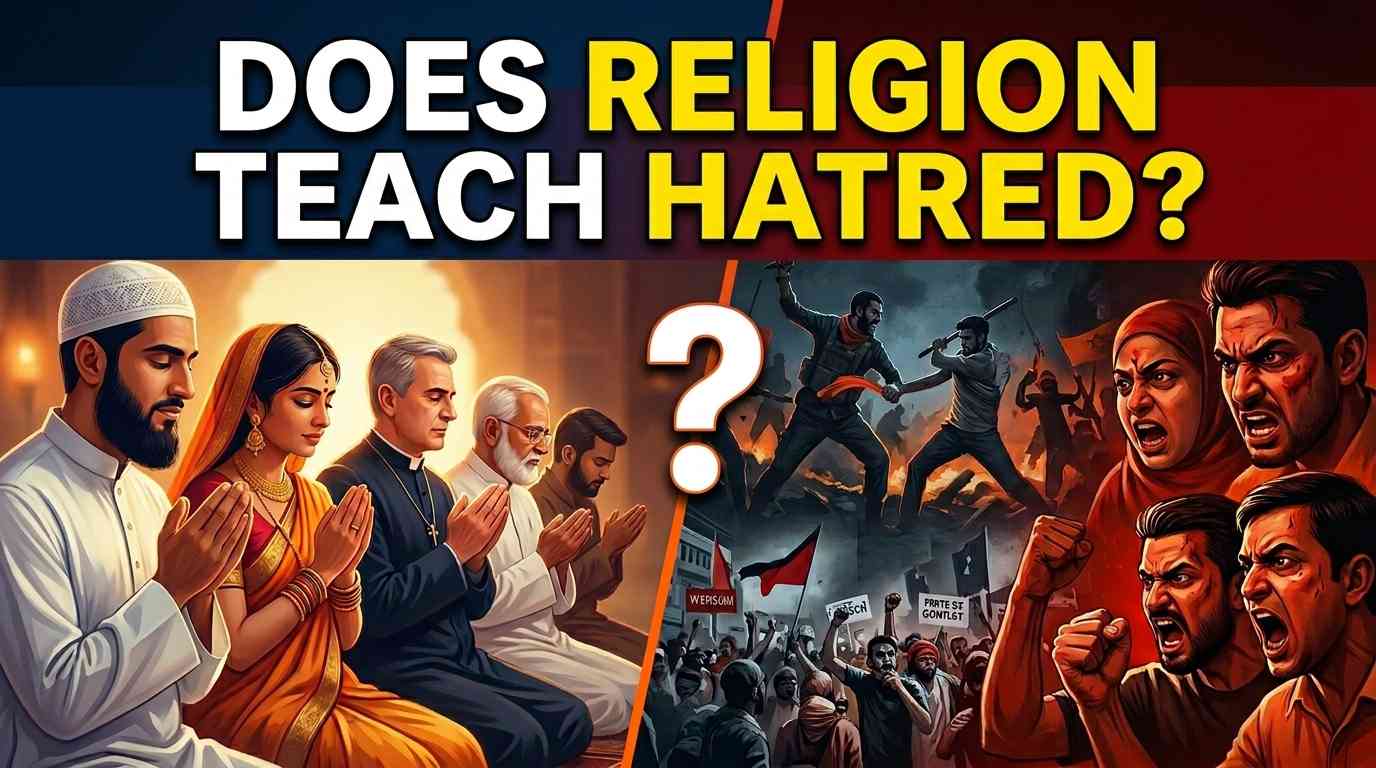
It is easy to spread hatred in the name of religion, but understanding the true message of religion is much deeper. Let us explore whether religion divides people or guides them back toward humanity.
Throughout human history, religion has had a deep influence on people’s lives. When human beings searched for answers about life, death, justice, injustice, responsibility, relationships and inner peace, religion often provided moral direction. Religion does not only teach rituals or customs; in many cases, it also teaches the purpose of life, the difference between right and wrong, responsibility toward others and the importance of living peacefully in society.
However, in real life, we often see people using the name of religion to spread hatred, insult others, create division or even promote conflict. This naturally raises an important question: Does religion really teach hatred? Or do people misuse religion because of selfish interests, fear, ignorance and narrow-minded thinking?
What Is the Main Purpose of Religion?
Religion generally helps in the development of the inner self, the formation of moral character and the creation of a foundation for good behavior in society. The main purpose of religion is to guide people toward honesty, tolerance, responsibility, self-control and justice. What clothes a person wears, what language they speak or where they were born are less important than their behavior, character and humanity.
When religion is understood correctly, it makes a person humble, not arrogant; compassionate, not cruel; peaceful, not violent. The real beauty of religion can be seen in a person’s behavior, willingness to help others, courage to speak the truth and ability to respect the rights of others.
Love and Compassion
One of the greatest teachings of religion is learning to understand the suffering of others.
A truly religious person does not think only about personal benefit. Such a person becomes sensitive to the pain, helplessness and needs of others. Without compassion, religious life becomes limited to outward practices and loses its deeper moral value.
Justice and Responsibility
Justice is one of the strongest foundations of both religious and human life.
Religion teaches people not to violate the rights of others, not to ignore the weak and not to misuse power. Whether in the family, society, workplace or nation, peace cannot remain strong without justice and responsibility.
Coexistence and Mutual Respect
Living peacefully with people of different opinions, cultures and beliefs is a powerful human quality.
Not everyone in the world will think in the same way, and that is completely natural. The true teaching of religion encourages people to choose respectful dialogue instead of insult, hatred or violence, even when there are differences of opinion.
Then Why Is Hatred Spread in the Name of Religion?
Even if religion itself is not the source of hatred, people’s wrong interpretations, ignorance, fear, political interests, social division and provocative speech can create hatred. When people do not understand the deeper moral teachings of religion and focus only on external identity, suspicion, disrespect and hostility can grow toward others.
Hatred often does not come directly from religion; rather, it comes from human weakness. When someone tries to make their own identity look superior by making another identity look inferior, they may use religion as a tool. But that is not the ideal of religion; that is the narrowness of human thinking.
Common Causes of Hatred
- Half-knowledge or wrong knowledge about religion
- Fear or misunderstanding about other beliefs
- Rumors, misinformation and provocative speech
- Using religion for political or personal interests
- Lack of education and lack of critical thinking
- The tendency to insult others in order to prove one’s own identity
True Religious and Human Values
- Respecting human beings
- Staying away from injustice
- Practicing forgiveness and patience
- Standing beside weak and helpless people
- Maintaining truth, honesty and justice
- Choosing the path of peace and coexistence
Religion Is Not the Only Proof; Human Behavior Matters More
What a person believes may be important, but how that person behaves is even more important. If someone speaks about religion but insults others, hurts the weak, spreads lies or encourages hatred, then their behavior does not represent the beauty of religion.
True religious consciousness is reflected in character. It is easy to speak good words, but it is much harder to remain patient, forgive others, respect people’s rights, stand against injustice in a fair way and help those who are in need. These actions are the real signs of values.
A Simple Example: The Compass and the Traveler
Religion Is Like a Compass
A compass can show the right direction, but if the traveler intentionally walks the wrong path, the compass is not to blame. In the same way, religion may show a moral path, but if people misuse it for selfish purposes, the fault lies in human misuse, not in the guidance itself.
This example teaches us an important lesson. Any teaching, book, principle or ideal becomes useful only when people understand it honestly and apply it sincerely. Memorizing good words does not make a person good; applying those words in real life gives them true value.
Religious Teaching vs. Hatred in the Name of Religion
The teaching of religion and hatred spread in the name of religion are not the same thing. Many people mix these two ideas together, and as a result, misunderstanding about religion grows. The comparison below can help make the difference clearer.
| Topic | True Teaching of Religion | Hatred in the Name of Religion |
|---|---|---|
| View of People | Respecting people and honoring human dignity | Looking down on others or treating them as enemies |
| Language and Behavior | Gentle speech, patience and humility | Insults, abusive words, provocation and hateful speech |
| Difference of Opinion | Discussion, understanding and peaceful coexistence | Conflict, division and hostility |
| Power | Responsibility and justice | Dominance and selfish gain |
| Goal of Society | Peace, morality and human welfare | Fear, division and mistrust |
How Ignorance Strengthens Hatred
People often fear what they do not understand. Fear can slowly turn into hatred. If we have little knowledge about people of different religions, cultures or ways of life, we can easily become victims of false ideas. These false ideas create suspicion, distance and division.
That is why knowledge, education and dialogue are powerful tools against hatred. When we listen to other people, try to understand their experiences and question our own assumptions, our minds become broader. We begin to understand that difference does not automatically mean enmity.
Knowledge + Compassion = Peace
Respect Is Necessary Even When Opinions Differ
Differences of opinion will always exist in society. Everyone will not believe the same things, think in the same way or live life in the same style. But the beauty of a civilized society is that people maintain respect even when they disagree. Debate may exist, but insult should not. Questions may exist, but hatred should not.
If we turn disagreement into hostility, society becomes weaker. But if we see disagreement as an opportunity for understanding, society becomes stronger. That is why the use of language is very important in religious or social discussions. Peaceful language can make even difficult topics easier, while hateful language can turn even simple matters into conflict.
Language We Should Avoid
- Insulting another person’s belief
- Blaming an entire community for one person’s action
- Using mockery, harsh words or provocative expressions
- Spreading rumors or unverified information
- Turning disagreement into personal attack
Language We Should Use
- “I want to understand your point of view.”
- “We may disagree, but let us keep respect.”
- “Let us verify the information before discussing it.”
- “One person’s mistake should not be blamed on an entire group.”
- “A calm discussion makes solutions easier.”
One Person’s Mistake vs. Blaming an Entire Community
One major mistake in society is blaming an entire community, culture or belief system because of the wrongdoing of one individual. This is not fair. No society, profession, family or group is completely the same. Good and bad people can be found everywhere.
The wrong action of one person is that person’s individual responsibility. Using that mistake to insult the identity, belief or culture of millions of people is unjust. It does not solve the problem; instead, it creates more distance and mistrust.
Religion and Humanity in the Modern World
Today’s world is more connected than ever before. People move from one country to another, work with people from different cultures, study together and live side by side. In such a society, peaceful coexistence is not only a good quality; it is a necessary life skill.
If religion teaches morality, then the real test of that morality happens in daily life: on the road, at work, within the family, on social media and in conversations with people who think differently. The true beauty of religion becomes visible when a person remains humble despite having power, controlled despite anger and respectful despite disagreement.
What We Can Do to Build a Peaceful Society
- Do not judge someone before learning about their religion or belief
- Verify facts before sharing rumors, provocative posts or hateful content
- Do not treat one person’s mistake as the mistake of an entire community
- Speak respectfully with people who hold different opinions
- Teach children and young people tolerance, humanity and moral values
- Keep religious discussions calm, logical and humane
- Show love, honesty and justice through personal behavior
- Practice responsibility, not hatred, on social media
Religious Hatred on Social Media
Social media can become a major medium for spreading hatred if people are not responsible. A false piece of information, an edited statement, an emotional image or a provocative post can reach many people very quickly. This can create misunderstanding, tension and conflict in real life.
Therefore, we need to be more careful when speaking about religion or social issues online. Freedom of expression is important, but it also comes with responsibility. We should avoid saying anything that unnecessarily insults, provokes or divides people.
| What Did You See Online? | What Should You Do? | Why Is It Important? |
|---|---|---|
| Provocative post | Verify before sharing | False information can spread hatred quickly |
| Insulting comment about religion | Respond calmly or report it | Insult in response to insult makes the situation worse |
| One-sided description of an incident | Compare with reliable information | One-sided information can create wrong conclusions |
| Discussion with a different opinion | Give arguments respectfully | Peaceful language makes discussion productive |
The Role of Family and Education
Family and educational institutions play a very important role in reducing hatred. What children see and hear from an early age has a strong effect on their thinking. If they hear elders speaking with disrespect, hatred or insult toward others, they may begin to think that such behavior is normal.
That is why children should be taught that people may have different identities, but respect is necessary for everyone. Education is not only for exam marks; education expands thinking, teaches tolerance and helps people become responsible citizens.
What Should Children Learn?
Children should learn humanity and respect from an early age.
Children should be taught that it is wrong to insult someone based on name, clothing, language, food habit or belief. A person should be judged by behavior, honesty, kindness and responsibility.
Humanity Should Be at the Center of Every Discussion
Religious identity may be an important part of a person’s life, but humanity is a value needed by all people. Feeding the hungry, helping the sick, standing beside someone in danger, speaking the truth and protecting the rights of others are actions that show human character.
If a religious discussion makes people kinder, more honest, more controlled and more just, then that discussion is useful. But if any discussion makes people arrogant, angry, divisive or hateful, then there is a need for self-reflection.
Time to Ask Ourselves
We often notice the mistakes of others but forget to examine our own behavior. If we truly want to think about religion and humanity, we must also ask ourselves some honest questions. These questions help us practice self-reflection.
Important Questions to Ask Yourself
- Can I respect people who think differently from me?
- Do I believe or spread information without verifying it?
- Do I blame an entire group because of one person’s mistake?
- Is my language peaceful or provocative?
- Am I using religion to become humble or to become arrogant?
- Does my behavior make others feel safe and respected?
The Journey from Hatred to Peace
Hatred is not created in one day, and it cannot be removed in one day either. To reduce hatred, responsibility is needed in families, education, society, media, religious leadership and personal behavior. People should be guided through understanding, not fear. Discussions should be based on respect, not insult.
Peace does not only mean the absence of conflict. Peace also means justice, safety, respect and mutual trust. Therefore, instead of spreading hatred in the name of religion, we should use the moral teachings of religion in the service of humanity.
The Path of Hatred
- Seeing others as enemies
- Insult and provocation
- Spreading rumors
- Creating fear
- Breaking relationships
The Path of Peace
- Seeing others as human beings
- Respect and dialogue
- Verifying information
- Increasing compassion
- Building relationships
Conclusion: Where Is the Real Strength of Religion?
The real strength of religion is not in hatred; the real strength of religion is in improving the human heart. If a person speaks about religion but does not show kindness, justice, honesty, patience and respect in behavior, then the outer form of religion may be present, but deep moral value is missing.
So the answer is: religion itself does not teach hatred; hatred comes from wrong interpretation, ignorance, selfishness and narrow-minded thinking. When religion is understood properly and practiced with humanity, it can help people become better human beings.
To build a beautiful society, we need more than religious identity; we need human character. We need people who do not fear differences but try to understand them. We need language that does not break people apart but brings them together. We need education that teaches peace, not hatred.
Key Message
The true teaching of religion is not hatred; it is love, justice, compassion, self-control and humanity. The value of any belief or ideal is truly shown when it makes human behavior more peaceful, responsible and humane.