Table of Contents
Types of Trees in Data Structures: Explained
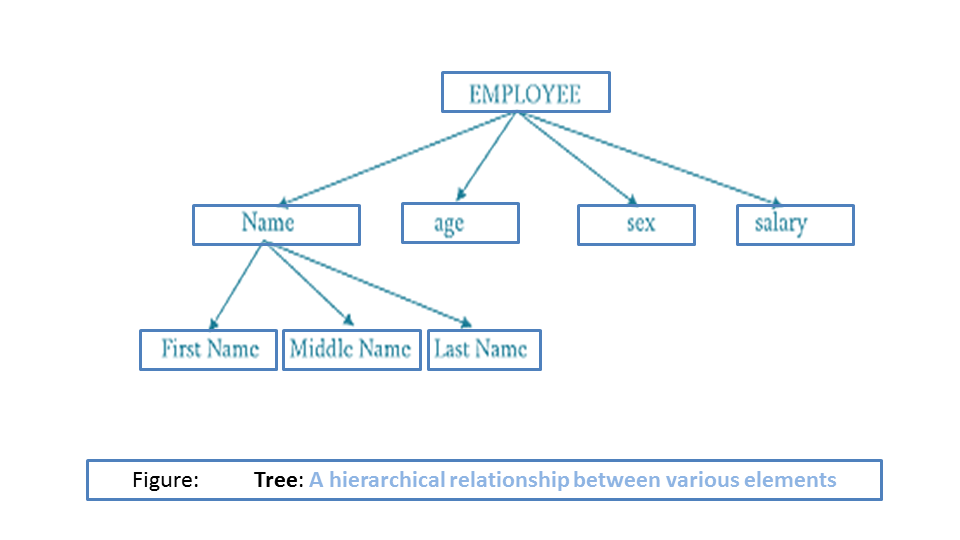
Data frequently contain a hierarchical relationship between various elements. The data structure which reflects this relationship is called a rooted tree graph or simply a tree. Among the different types of data structures in practice, a tree is very important to store and manipulate data with a complex relationship. This is sometimes like the properties of an object. For example, properties to store of an employee in the office directory can be named, age, sex, salary etc. Again the properties “name” can have sub-properties like first name, middle name, last name etc. This can be shown as follows.
There are different types of tree data structures. Some of them are
- Binary Tree
- Complete Binary Tree
- Binary search tree
- AVL tree or height-balanced binary tree
- Red-Black tree
- Splay tree
- N-ary tree
- Trie Structure
- Suffix tree
- Huffman Tree
- Heap Structure
- B-Tree
- B+- tree
- R-Tree
- Counted-B Tree
- K-D tree ( or K- dimensional BST)
- Decision tree ( a variant of the n-ary tree)
- Markel tree,
- Fenwick tree ( or binary index tree)
- Range Tree.