What is a Logic Gate?
What is a Logic Gate?
A Logic Gate is an electronic circuit that operates on one or more input signals to produce an output signal.
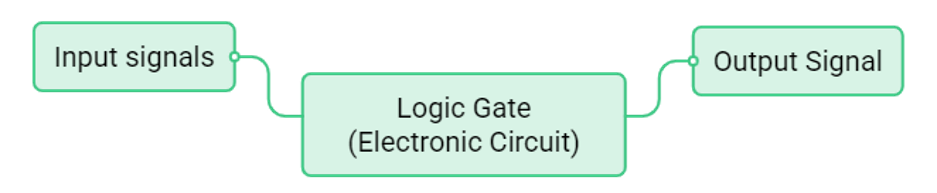
Logic gates are the basic building blocks of digital electronics and computer systems.
Digital Circuits
Gates are called digital (two-state) circuits because their input and output signals have only two states:
- Low Voltage → Represents 0
- High Voltage → Represents 1
Logic gates are also known as logic circuits because they can be analyzed using Boolean Algebra.
Basic Logic Gates
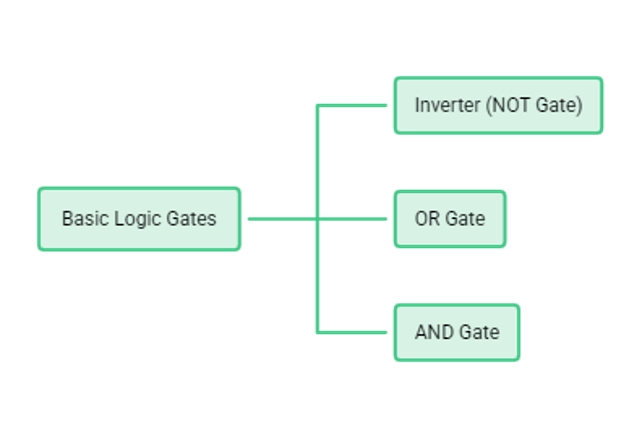
There are three basic logic gates:
- Inverter (NOT Gate)
- OR Gate
- AND Gate
1. Inverter (NOT Gate)
A NOT gate produces the opposite output of the input.
If the input is 1, the output becomes 0, and if the input is 0, the output becomes 1.
2. OR Gate
An OR gate gives output 1 if one or more inputs are 1.
The output becomes 0 only when all inputs are 0.
3. AND Gate
An AND gate gives output 1 only when all inputs are 1.
If any input is 0, the output becomes 0.
Applications of Logic Gates
- Computers
- Digital calculators
- Mobile phones
- Memory devices
- Control systems
Conclusion
Logic gates are essential components of digital electronics. They perform logical operations using binary signals (0 and 1) and form the foundation of modern computer systems.