Java if-else-if Ladder: Conditional Statements Explained
-
"What is the purpose of using an if-else-if ladder in programming, and why is it important?"
-
"Why is the if-else-if ladder essential in programming, and what benefits does it provide?"
-
"What advantages does the if-else-if ladder offer in decision-making within code?"
-
"In what ways does the if-else-if ladder enhance code functionality and clarity?"
-
"What are the key reasons for implementing an if-else-if ladder in programming?"
The if-else-if ladder is a crucial control structure in programming, including languages like C, C++, C#, Java, for several reasons:
1. Multiple Conditions
The if-else-if ladder allows programmers to check multiple conditions sequentially. This is essential when there are several possible scenarios to evaluate, and each condition may lead to different outcomes.
2. Clear Logic Flow
Using an if-else-if ladder provides a clear and organized way to handle decision-making in code. It helps in structuring the logic in a readable manner, making it easier for developers to understand and maintain the code.
3. Efficient Execution
Once a true condition is found, the subsequent conditions are skipped. This means that the program doesn't need to evaluate all conditions, making the execution more efficient, especially when there are many conditions.
4. Handles Default Cases
The final else block provides a way to handle default cases when none of the specified conditions are true. This ensures that the program can respond appropriately, even when the expected conditions are not met.
5. Improved Debugging
With a well-structured if-else-if ladder, debugging becomes easier. Programmers can quickly identify which condition was true and trace through the logic to find issues or optimize performance.
6. Flexibility
The if-else-if ladder is versatile and can handle a wide range of logical conditions. It can also be nested within other if statements, allowing for complex decision trees that can accommodate intricate logic requirements.
7. Code Readability
Structured conditions enhance the readability of code. Developers can easily see the different paths the code may take, which aids in comprehension and facilitates collaboration in team environments.
Example Scenario
For example, consider a grading system where students receive different messages based on their scores:
- If the score is above 90, print "Excellent!"
- If the score is between 80 and 90, print "Good job!"
- If the score is between 70 and 80, print "You passed!"
- Otherwise, print "You need to improve."
This situation is perfect for an if-else-if ladder, as it clearly separates the logic for different ranges of scores.
Summary
In summary, the if-else-if ladder is significant in programming because it provides a structured, efficient, and readable way to evaluate multiple conditions, making decision-making in code both clear and effective.
if else if ladder
In this section we will learn about Decision Making in java if-else-if ladder.
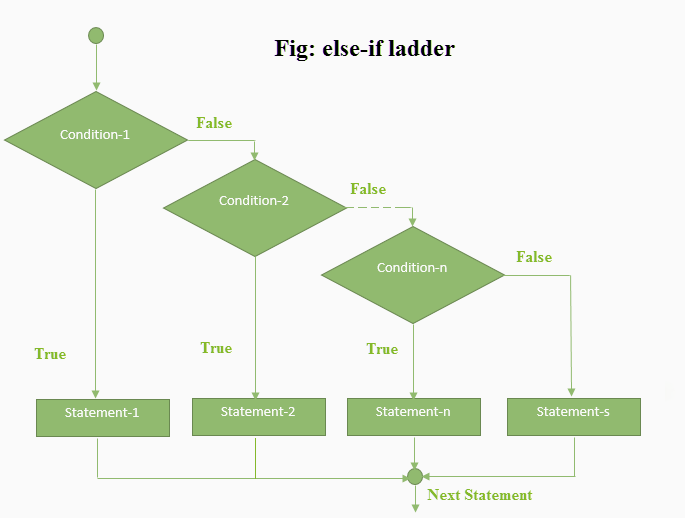
Syntax
if(condition1){
  //code to be executed if condition1 is true
}
else if(condition2)
{
  //code to be executed if condition2 is true
}
else if(condition3){
  //code to be executed if condition3 is true
}
...
else{
  //code to be executed if all the conditions are false
}
Practical Approach of if else if Ladder
//IfElseLadder.java

    class IfElseLadder
    {
        public static void main(String args[])
        {
             int x = 40;

			      if( x == 5 ) {
			         System.out.println("Value of X is 5");
			      }else if( x == 10 ) {
			         System.out.println("Value of X is 10");
			      }else if( x == 30 ) {
			         System.out.println("Value of X is 30");
			      }if( x == 35 ) {
			         System.out.println("Value of X is 35");
				  }else{
					  System.out.println("This is else statement");
				     }

        }
}This is else statement
Press any key to continue . . .Another example of if else if Ladder
import java.util.Scanner;
public class IfElseIfExample {
public static void main(String[] args) {
	int marks;
    System.out.println("Enter Marks");
    Scanner sc = new Scanner(System.in);

    marks=sc.nextInt();

if(marks=50 && marks=60 && marks=70 && marks=80 && marks=90 && marksEnter Marks
75
B grade
Press any key to continue . . .